
Your hair is thinning, your scalp feels different, or shedding has suddenly increased. You know it is time to get help, but the next question is confusing: should you see a trichologist or a dermatologist?
The short answer depends on what you need from the appointment. A dermatologist is a medical doctor who can diagnose and treat diseases affecting the skin, hair, nails, and scalp. A trichologist focuses specifically on hair and scalp concerns, but the title alone does not mean the practitioner is a physician. Training and legal scope can vary, so it is important to check the person's actual credentials.
A responsible trichologist does not compete with dermatology. The two roles can complement each other when the boundaries are clear. This guide explains those boundaries, what each appointment may include, and how to decide where to start.
Choose the provider based on the question you need answered, not simply the title that sounds most specialized.
Kristy Jarrett, CT Certified Trichologist and Second Generation Hair DoctorTrichologist vs Dermatologist at a Glance
Trichologist
- Focuses specifically on hair and scalp concerns
- Reviews visible patterns, history, routine, products, and styling practices
- May use scalp magnification and standardized photographs
- Can offer non-prescription care, education, monitoring, and referral guidance within training and local scope
- Is not automatically a medical doctor or licensed healthcare professional
Dermatologist
- Is a physician specializing in skin, hair, nails, and scalp
- Can make a medical diagnosis
- Can order appropriate laboratory tests or perform a scalp biopsy
- Can prescribe medication and provide medical procedures
- Is the right choice for suspected disease, infection, scarring, or rapidly worsening loss
What Does a Trichologist Do?
Trichology is the focused study of hair and scalp health. During a professional assessment, a trichologist may review when the concern began, how it has changed, your family history, recent stress or illness, medications, nutrition, chemical services, protective styles, heat use, products, wash routine, and maintenance habits.
The value of that focused history is context. A person who sees short pieces around the crown after frequent heat styling may need a very different plan from someone losing full-length strands after an illness. A client with tension around the hairline needs different guidance from someone with a widening part. A detailed assessment can help organize those observations instead of treating every concern as a generic need for a growth oil.
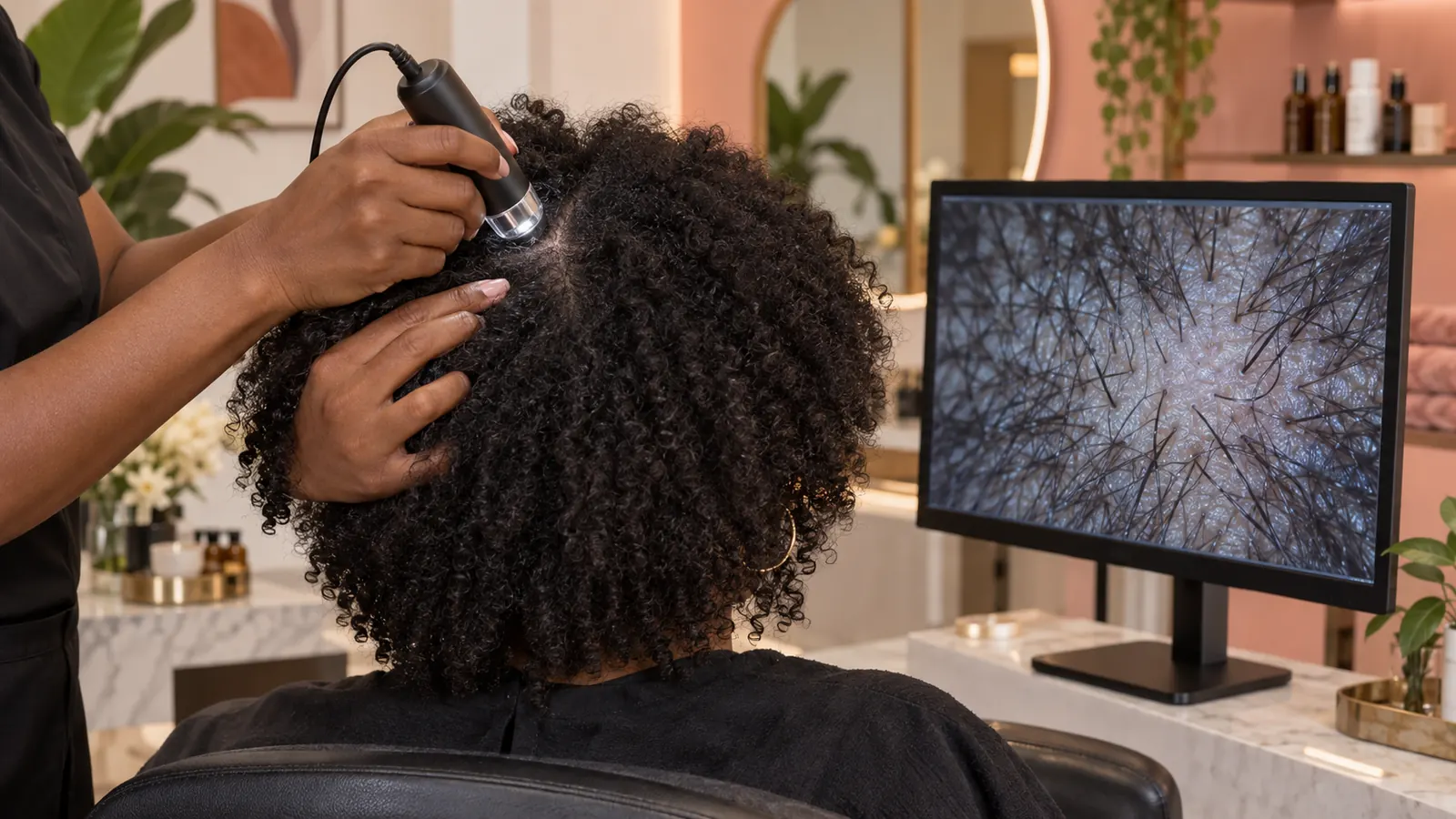
A trichologist may also examine visible density, breakage, flaking, buildup, redness, and the condition of the hair shaft. In-person services may include magnified scalp imaging. These observations can guide hair care, scalp care, styling changes, non-prescription support, progress photographs, and an appropriate referral.
The limit matters. A trichology credential by itself does not establish authority to prescribe medication, diagnose a systemic illness, order medical testing, perform a biopsy, or treat an infection. Those services require an appropriately licensed healthcare professional. The Institute of Trichologists also states that trichologists are not medically qualified unless they hold separate medical qualifications.
What Does a Dermatologist Do for Hair Loss?
A dermatologist is a medical doctor with training in conditions involving skin, hair, nails, and mucous membranes. Hair loss is part of dermatology, not an issue outside it. The American Academy of Dermatology recommends a board-certified dermatologist when an accurate hair loss diagnosis is needed.
A dermatologist may ask about the speed and pattern of loss, examine the scalp and other areas, perform a hair pull test, and review symptoms, medications, family history, pregnancy, illness, weight change, or other health factors. When needed, the medical workup can include blood tests, fungal testing, or a scalp biopsy. Treatment may involve prescription medication, injections, medical procedures, or a plan to monitor a condition.
This is especially important because different forms of hair loss can resemble one another early on. Diffuse shedding can overlap with female pattern hair loss. Traction-related thinning can occur alongside another condition. Some inflammatory or scarring disorders may begin with symptoms that seem mild. The correct medical treatment depends on the correct diagnosis.
When Should You See a Dermatologist First?
Choose medical evaluation first when the main question is whether you have a disease, infection, inflammatory disorder, medication effect, nutritional problem, hormonal condition, or another health-related cause. You do not need to identify the condition yourself before booking.
Arrange a dermatologist or other appropriate medical appointment promptly if you notice:
- Sudden round patches or rapidly increasing hair loss
- Intense itching, burning, pain, or tenderness with hair loss
- Redness, swelling, open sores, drainage, or pustules
- Heavy scale, crusting, or signs of a possible infection
- Smooth or shiny areas where follicle openings are difficult to see
- Hairline recession together with eyebrow loss
- Hair loss accompanied by unexplained fatigue, weight change, fever, or menstrual changes
- A need for prescription treatment, medical testing, or biopsy
The AAD notes that burning, tenderness, pus, sores, and sudden hair loss can occur with conditions that need medical assessment. Early evaluation can matter for types of hair loss that may become permanent. Our guides to burning scalp, scalp inflammation, and alopecia areata explain why symptoms and patterns should not be diagnosed from appearance alone.
When Can a Trichologist Be a Useful Starting Point?
A trichologist may be useful when you want a focused, structured review of your hair and scalp, especially when routine, styling, product use, breakage, tension, or maintenance may be contributing. The appointment can also help you document a concern clearly before speaking with a medical provider.
Common reasons include:
- Trying to tell the difference between breakage and shedding
- Reviewing a wash routine, product layering, buildup, or scalp comfort
- Understanding how braids, wigs, relaxers, heat, or extensions affect the hair
- Planning lower-tension styling after traction-related hairline changes
- Comparing cosmetic coverage or non-surgical hair replacement options
- Tracking visible changes with consistent photographs
- Getting practical support alongside a dermatologist's medical plan
The best appointment should end with a clear explanation of what was observed, what can be addressed within the provider's scope, what should be monitored, and what requires referral. Be cautious if any non-medical provider promises a cure, guarantees regrowth, tells you to stop prescribed treatment, or presents magnified images as proof of a medical diagnosis.
Can You See Both a Trichologist and a Dermatologist?
Yes. For many people, this is the most practical approach. The dermatologist can lead medical diagnosis and treatment. The trichologist can help translate that plan into day-to-day hair and scalp care, review styling tension and breakage, document progress, and support cosmetic decisions.
For example, a dermatologist may diagnose female pattern hair loss and prescribe treatment. A trichologist can then help the client choose gentle styling practices, reduce avoidable breakage, establish a scalp routine, and monitor consistent photographs. A dermatologist may treat an inflammatory scalp condition while a trichologist helps the client avoid products or services that aggravate the scalp.
Keep communication clear. Share your medication and diagnosis accurately. Do not stop or change a prescribed treatment based on non-medical advice. If recommendations conflict, ask the prescribing clinician before making a change.
Questions to Ask Before You Book
Professional titles can sound similar online. These questions help you understand exactly what you are purchasing:
- What qualifications and active professional licenses do you hold? Ask for the exact credential rather than relying on a nickname or business title.
- Is this a medical appointment or a non-medical hair and scalp assessment? The answer should be direct.
- What can you diagnose, prescribe, test, or treat under your license? A responsible provider should explain the limits without hesitation.
- What is included in the appointment? Ask about history, scalp imaging, strand review, written recommendations, follow-up, and total time.
- When do you refer to a dermatologist or physician? A clear referral process is a sign of responsible practice.
- Will products or services be recommended during the appointment? Ask whether the analysis fee is separate from any treatment or product purchase.
Where GlamorChiQ's Hair and Scalp Analysis Fits
GlamorChiQ offers a professional Hair and Scalp Analysis virtually and in Memphis. The session reviews your concerns, history, routine, styling practices, visible scalp patterns, and strand condition. In-person analysis may include microscopic scalp imaging and strand testing.
The goal is to give you a plain-language review of observable patterns and practical next steps. That may include home-care changes, a suitable GlamorChiQ service, progress monitoring, or medical referral when appropriate. The analysis does not replace medical diagnosis, prescription treatment, laboratory testing, or biopsy.
If you already have a dermatologist, bring the diagnosis and current plan so the hair-care discussion can support it. If you have red-flag symptoms or need a medical diagnosis, arrange medical care rather than delaying it for a non-medical service.
Want a structured review of what you are noticing?
Request a virtual or in-person Hair and Scalp Analysis with GlamorChiQ for a focused review of your history, routine, visible patterns, and practical next steps.
Choose Your AnalysisFrequently Asked Questions
Choose a dermatologist when you need medical diagnosis, prescriptions, laboratory testing, biopsy, or treatment for suspected disease. A trichologist can be useful for a focused hair and scalp review, routine and styling guidance, non-prescription support, monitoring, and referral guidance. Some people benefit from both.
A trichology credential alone does not establish a medical license. A non-medical trichologist can observe patterns and recommend referral, but medical diagnosis should come from an appropriately licensed healthcare professional such as a dermatologist.
Yes. Dermatologists diagnose and treat conditions involving the skin, hair, nails, and scalp. Depending on your symptoms, they may examine the scalp, order tests, perform a biopsy, prescribe medication, or recommend a procedure.
At GlamorChiQ, the session reviews your concerns, history, routine, styling practices, visible scalp patterns, and strand condition. In-person analysis may include microscopic scalp imaging and strand testing. It provides practical next steps and does not replace medical diagnosis.
Yes. A dermatologist can lead medical diagnosis and treatment, while a trichologist may support hair-care routines, scalp care, styling changes, cosmetic options, and progress documentation within the practitioner's scope.