
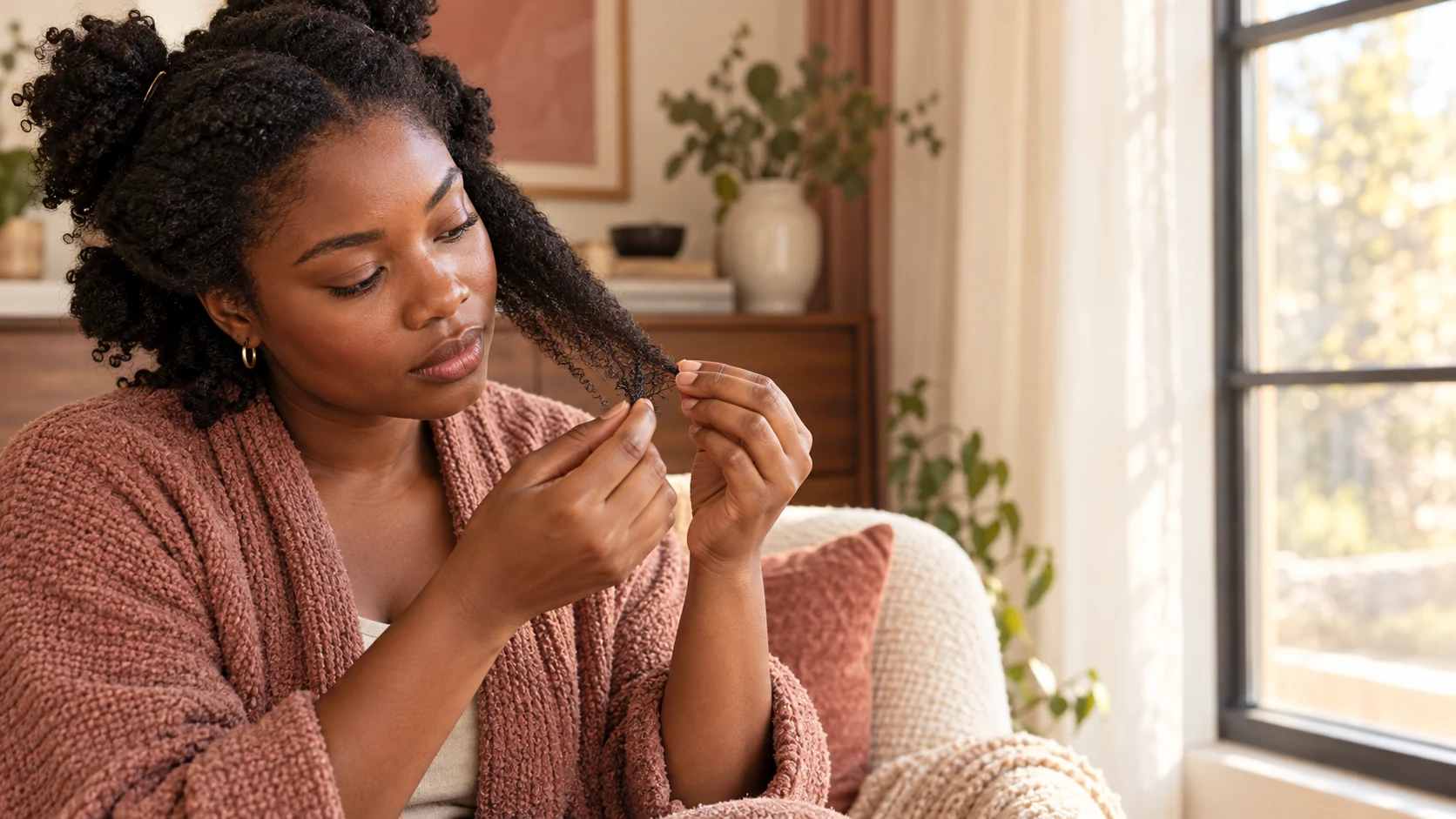
You smooth a section of 4C hair and feel a tiny hard point near the end. It may be a single-strand knot, often called a fairy knot: one strand has looped around itself and tightened. A few knots are common in tightly coiled hair, but frequent knots can turn detangling into repeated breakage and make length retention difficult.
The goal is not to promise knot-free hair. It is to reduce the conditions that let loose ends tangle, identify when an end needs trimming, and prevent one knot from collecting neighboring strands.
What a Single-Strand Knot Looks and Feels Like
A true single-strand knot is a small knot tied in one hair fiber. It often feels like a bead or rough point when fingers slide down the strand. It differs from a shed hair wrapped around several strands, a product flake, or a multi-strand tangle.
Use bright light and avoid pulling. If the point moves with residue, it may not be a knot. If several hairs are involved, add water and slip before separating them. Pulling until something snaps trades a knot for a broken, weathered end.
Why Coily Hair Knots
As a loose coil shrinks, its end can cross the same strand and form a loop. Movement from washing, loose styles, wind, clothing, and sleep gives that loop more opportunities to tighten. Shed hairs that remain in a dense section can wrap around live strands and create larger tangles.
Knots are more likely when ends are rough, split, overdue for trimming, or handled without enough lubrication. They may also collect where two different textures meet during a transition from relaxed to natural hair.
Wash in Organized Sections
Before washing, divide the hair according to density and gently remove loose shed strands. Keep each section directed downward while water and cleanser move through it. Do not pile the lengths on top of the head or scrub them together.
Rinse thoroughly and keep finished sections separate. If the hair repels water or feels coated, the low-porosity 4C wash-day guide explains how buildup and heavy layering can interfere with slip.
Use Conditioner for Slip, Not Just Softness
Conditioner should make the strands easier to separate. Apply enough water and product to the interior of each section, then smooth from ends upward. If a product disappears without improving slip, change the amount, water balance, or formula rather than forcing the comb through.
Detangle while the hair is damp and lubricated. Hold above the working area, remove large tangles with fingers, and use a wide-tooth comb or flexible tool only when it passes without repeated snapping.
Pay Attention to the Ends
The oldest part of the strand has experienced the most washing, heat, friction, and styling. Ends that split into multiple branches or catch on each other create more opportunities for knots. Dusting damaged tips can improve manageability, while cutting on an arbitrary calendar can remove healthy length unnecessarily.
Use professional hair shears on clean, visible strands. If an isolated knot will not loosen, cut just above it instead of tearing it through. Widespread roughness deserves a full assessment of heat, chemicals, tools, and trim needs.
Use Stretching Strategically
Twists, braids, banding, roller sets, and carefully controlled blow-drying can keep the ends more extended and organized. Stretching does not require making the hair straight. Choose the least force and heat that achieves the intended style.
Loose wash-and-go styles can be beautiful, but frequent shrinkage and daily manipulation may create more knots for some heads. Alternate styles based on what the ends show, not a rule about which technique is more natural.
Protect the Hair at Night
Place the hair in a few loose sections rather than sleeping on fully loose ends. Use a satin or silk bonnet, scarf, or pillowcase that stays smooth through the night. Move tight bands and scarf knots away from fragile areas.
Night protection cannot compensate for a matted style left untouched for too long. Refresh with water only when the hair can dry fully, and separate sections gently before they combine into larger tangles.
Avoid Solving Every Knot With More Product
Heavy butter can temporarily smooth a rough point while adding residue that makes the next wash harder. Oil can reduce friction for some routines but does not hydrate hair by itself or repair a split strand.
Use the smallest effective number of compatible products. If white residue, stickiness, dullness, or slow saturation appears, cleanse the buildup before layering more. Product performance should be measured by detangling, flexibility, breakage, and how the ends feel several days later.
When Knots Become a Breakage Problem
Look beyond the number of knots. Short pieces throughout the sink, uneven sections, splitting above the knot, and stalled retention show that the strands are breaking faster than expected. Compare this with the signs of breakage versus shedding.
If one area is consistently shorter, review the exact pressure and technique applied there. Crown-specific concerns are covered in the guide to 4C crown breakage.
A Practical Four-Wash Plan
For the next four washes, use the same gentle cleanser, slippery conditioner, detangling method, and simple style. Remove shed hair carefully, keep ends organized, and record how many rough knots require cutting. Avoid introducing several new products at once.
At the end, ask whether detangling is faster, ends feel smoother, and fewer short pieces appear. If not, examine trim needs, heat, chemical overlap, water quality, and the time between wash days.
When to Seek Professional Help
Single-strand knots concern the exposed hair fiber, but scalp pain, burning, sores, a widening part, or progressive density loss is a different problem. A hair and scalp analysis can document the pattern and routine. A dermatologist should assess suspected disease or unexplained hair loss.
For persistent shaft damage, bring the products and tools you use most often and describe the full wash-to-style process. Technique is often easier to improve when the entire sequence is visible.
Keep the ends organized without fighting your texture
Explore professional care designed around natural and textured hair, including cleansing, detangling, trimming, and styling support.
Explore Natural & Textured Hair CareFrequently Asked Questions
Tightly coiled strands can loop around themselves, especially when shed hair, friction, dry ends, or loose styling allows the ends to tangle.
A sharp hair shear can remove an isolated knot when it cannot be gently released. Do not rip it apart or use household scissors, which can leave a rough end.
No product can guarantee that coily hair will never knot. A suitable routine can reduce friction, improve slip, keep ends organized, and make knots easier to manage.
An occasional knot is common in tightly coiled hair. A sudden increase with splitting, snapping, roughness, or loss of length can signal that the routine or strand condition needs attention.
Low-tension twists, braids, or stretched styles can keep ends organized. They help only when installation, wear, cleansing, and removal do not create more tangling or breakage.