
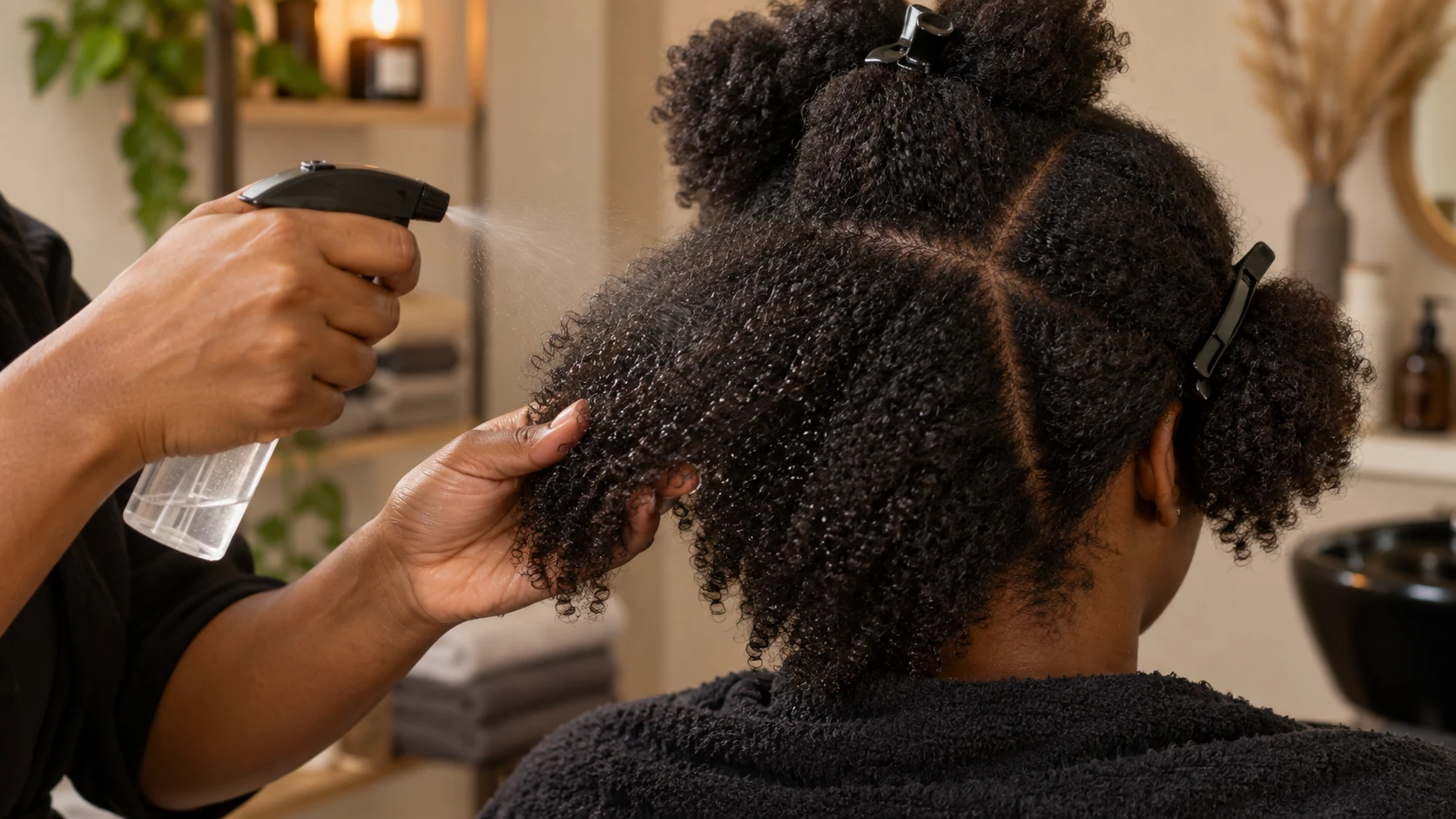
A low-porosity 4C hair routine should solve practical problems: getting the hair thoroughly wet, cleansing without leaving a film, conditioning with enough slip, and styling without stacking products that never seem to settle. It should not require a shelf full of products or a rigid set of internet rules.
Hair porosity describes how a hair fiber interacts with water and products. The 4C label describes a tightly coiled visual pattern. They are not the same measurement, and one does not automatically determine the other. Two people with 4C hair can have very different histories of heat, color, chemical processing, weathering, density, and product use, so their routines may need to differ.
Start With Behavior, Not a Glass-of-Water Test
The popular float test asks you to place a loose strand in water and judge porosity by whether it floats or sinks. That result can be affected by surface tension, product residue, oil, and the condition of a single strand. It is not a reliable basis for rebuilding an entire routine.
Pay attention to repeatable wash-day behavior instead. Does clean hair take time to become evenly saturated? Does a small amount of product remain visible or tacky after drying? Does the hair feel coated before it feels conditioned? Does clarifying occasionally improve the way water and conditioner spread? Those observations are more useful than assigning every problem to a porosity label.
Cleanse the Scalp and Remove the Film
Work in manageable sections and give water time to reach the hair before applying shampoo. Comfortably warm water can help distribute cleanser and conditioner, but it does not open and close the cuticle like a door. Apply shampoo primarily to the scalp, massage gently with the fingertips, and allow the lather to move through the lengths as you rinse.
If oils, butters, gels, or layered creams no longer rinse clean, use a clarifying wash when needed rather than adding another moisturizing product on top. Clarifying does not need to happen on a fixed weekly schedule. The right interval depends on product use, water, activity, and how the hair feels after an ordinary wash. Follow with conditioner and pay attention to whether the hair regains flexibility and slip.
Condition in Sections With Plenty of Water
Apply conditioner to thoroughly wet hair, section by section. Smooth it along the lengths and give it time to distribute before deciding that the product is not working. Adding a little more water and working the conditioner through may improve coverage more than adding a much larger amount of product.
A plastic cap or gentle warmth can make a conditioning step more comfortable and may help the product spread, but more heat is not better. Use the product directions and avoid temperatures that make the scalp uncomfortable. A conditioner cannot permanently repair every damaged area, but it can improve lubrication, manageability, and the way strands move past one another during detangling.
Detangle While the Hair Is Supported
Dense 4C hair can hide tangles until tension is applied. Detangle while the hair is conditioned and divided into sections. Start at the ends, support the section above the area you are working on, and move upward gradually with fingers or a suitable wide-tooth tool. Forcing through a resistant area turns a routine step into breakage.
Keep completed sections separated so they do not shrink back into one another. The goal is not to stretch every coil perfectly straight. It is to remove shed strands and tangles with the least unnecessary friction.
Use Fewer Styling Layers
Low-porosity routines often become complicated because each sign of dryness leads to another cream, butter, or oil. That can create a coating that makes the next wash harder and leaves the hair dull or sticky. Begin with water, then use a modest amount of leave-in or styler suited to the finish you want. Add more only after seeing how the first layer behaves.
Oil can reduce friction or help with the feel of the ends, but oil is not moisture and it does not need to cover the scalp. Heavy product at the roots can make cleansing more difficult. Product choice should also reflect density and strand size; dense hair is not necessarily made of thick strands, and fine 4C hair may be weighed down quickly.
Do Not Assume Low Porosity Means Protein-Sensitive
Porosity and protein response are often treated as if they are the same issue. They are not. Chemical processing, heat, weathering, and mechanical wear can change the condition of the fiber regardless of curl pattern. A protein-containing conditioner may feel useful on some damaged hair and too stiff or coating in another routine.
Judge the result after washing and styling. If the hair repeatedly feels rigid, tangles more, or loses flexibility after a product, stop using it and simplify. If hair is heavily bleached, relaxed, or breaking, a stylist can help separate product buildup from structural damage.
Dry the Roots and Protect the Ends
Low-porosity hair may take a long time to dry, especially when it is dense, heavily layered with product, or set in a compact style. Allow enough time for the roots and interior sections to dry. Going to bed with damp, compressed hair can increase tangling and make the scalp uncomfortable.
Use the lowest practical heat and keep airflow moving rather than concentrating high heat in one spot. Once dry, protect the ends from repeated rubbing and rough handling. A satin or silk surface may reduce friction, but the nightly routine should remain simple enough to repeat consistently.
A Practical Routine to Test for Four Wash Days
For the first wash, clarify if the hair is visibly coated; otherwise use a regular shampoo. Condition in sections, detangle with the conditioner in place, rinse well, and apply one leave-in plus one styling product. Dry completely and note the softness, definition, residue, and time required.
Repeat the same basic routine for several wash days before changing multiple products. If the hair feels coated, reduce the amount or remove one layer. If it feels rough and tangles quickly, review cleansing strength, conditioner slip, detangling technique, and heat. Changing one variable at a time makes it possible to learn what actually helped.
When the Problem Is More Than Porosity
Porosity does not explain scalp pain, persistent flakes, smooth bald areas, widening parts, or sudden shedding. It also does not explain every form of breakage. When the concern involves the scalp or a visible change in density, do not keep rebuilding a product routine while the pattern progresses.
For routine styling and maintenance, explore GlamorChiQ's Natural and Textured Hair services in Memphis. If you are trying to understand thinning, shedding, or a changing scalp, begin with Hair and Scalp Analysis so the next step reflects the concern you actually have.
Build a routine around your real hair
Bring your current products, wash-day challenges, and styling goals into a plan designed for your texture, density, and daily life.
Explore Natural Hair ServicesFrequently Asked Questions
No. The 4C label describes curl pattern, while porosity relates to how the fiber interacts with water and products. Processing, heat, weathering, and individual fiber differences can affect porosity.
Use repeatable wash-day observations instead of relying on a single strand floating in water. Notice saturation time, residue, conditioning response, drying time, and how clean hair behaves across several washes.
Gentle warmth may help a conditioner spread and make the step more comfortable, but high heat is unnecessary. Follow product directions and stop if the scalp becomes uncomfortable.
Not automatically. Porosity and protein response are different. Judge how a specific product affects flexibility, tangling, and feel, especially if the hair is chemically or mechanically damaged.