
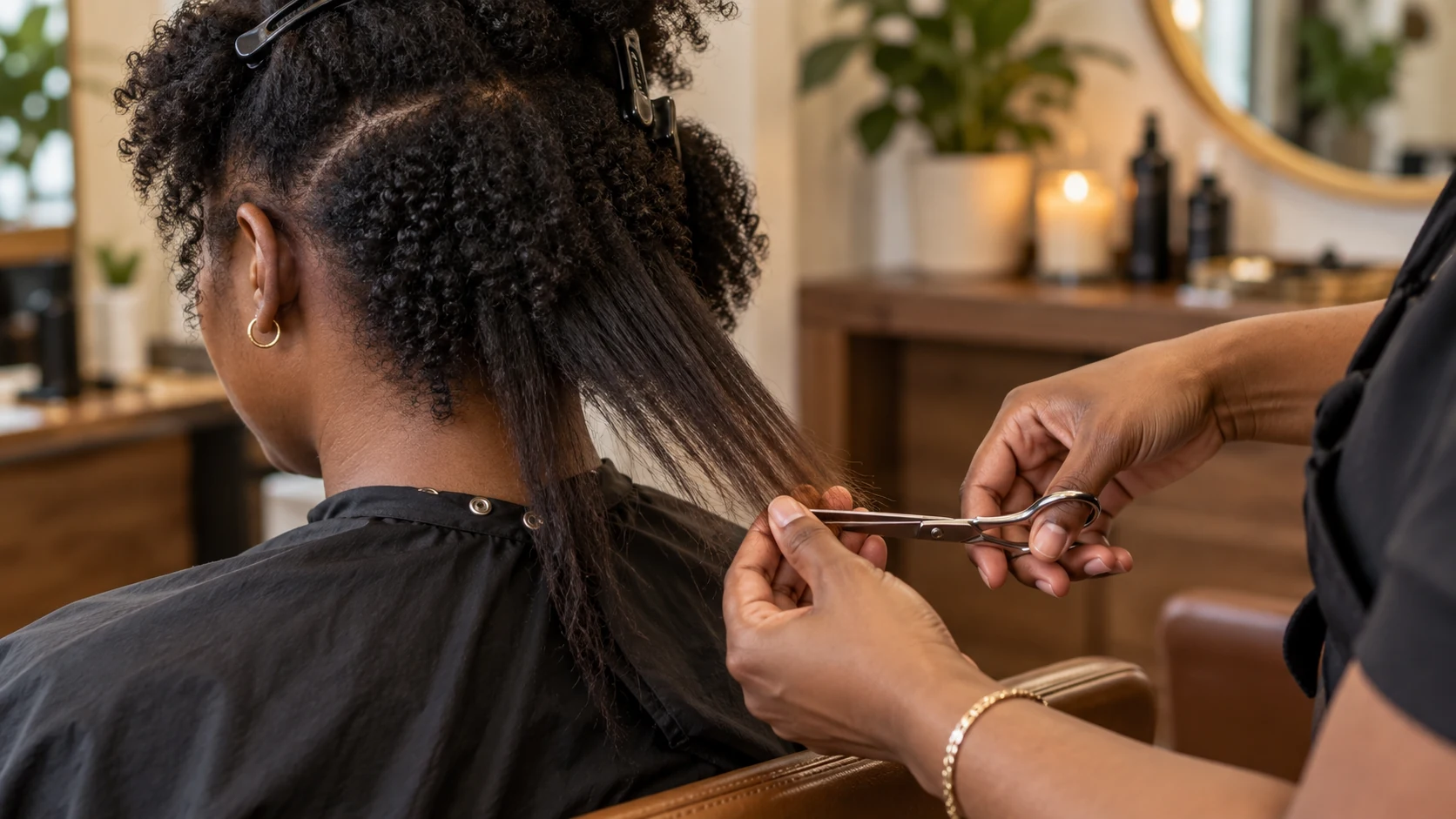
Transitioning from relaxed to natural hair means caring for two textures at once. New growth forms with its natural curl pattern while the older relaxed lengths remain chemically altered. The point where those textures meet is often the most vulnerable part of the strand, which is why a routine that once worked for fully relaxed hair may suddenly produce tangles and breakage.
You do not have to cut off every relaxed end immediately. A gradual transition can work when expectations, trims, detangling, and styling are planned around the condition of the hair. The goal is not to make both textures behave identically. It is to reduce stress while the natural section grows and the relaxed section is removed over time.
Choose Between a Gradual Transition and a Big Chop
A big chop removes most or all relaxed length and leaves the natural texture. It simplifies the two-texture problem but creates a shorter starting point. A gradual transition preserves more length while requiring extra time for sectioning, detangling, blending, and trimming.
Neither choice is healthier by definition. The better option is the one you can maintain without repeatedly straightening the new growth, pulling tightly to hide texture differences, or keeping ends that are splitting faster than they can be managed. Decide how much length you want to keep, what styles fit your daily life, and how frequently you are willing to trim.
Protect the Line Where the Textures Meet
The demarcation line is the area where natural new growth meets previously relaxed hair. The relaxed portion has undergone a chemical change, and the contrast in texture can concentrate stress during combing, stretching, and styling. Breakage may appear there even when the ends still look presentable.
Handle this area with support rather than pulling from the ends while the roots are tangled. Work in sections, add slip, and hold the hair above the knot while detangling below it. If a section repeatedly snaps at the same point, reduce manipulation and consider trimming more of the weakened length.
Build a Sectioned Wash-Day Routine
Divide the hair before washing so the natural roots do not shrink into the relaxed lengths as one large mass. Apply shampoo to the scalp and massage gently with the fingertips. Let the cleanser move through the lengths during rinsing instead of rubbing the relaxed hair together.
Use conditioner every wash and distribute it through each section. Give special attention to the demarcation line and ends, where lubrication can reduce friction during detangling. If product buildup makes the hair feel coated or the natural section no longer wets evenly, clarify when needed and follow with conditioner rather than adding more oil over the film.
Detangle for Two Different Textures
Detangle while the hair is damp and conditioned, beginning at the ends and moving upward in small sections. Fingers can locate larger knots before a wide-tooth tool passes through. Keep each completed section twisted or clipped so it does not retangle while you work elsewhere.
Do not judge success by how quickly you finish. Rushing, combing dry roots, or repeatedly dragging a tool from root to end can turn ordinary shed hair into a knot and snap the relaxed length. If wash day consistently takes too long, use more sections or shorten the transition with a planned trim.
Blend Textures Without Repeated High Heat
Styles that create a similar pattern from root to end can make the transition easier to wear. Twists, braid-outs, roller sets, flexi-rod sets, and other low-tension options can blend the textures without requiring the natural roots to remain straight.
Heat is not forbidden, but frequent high heat can add another source of damage during an already fragile stage. Use a heat protectant, the lowest effective setting, and fewer passes. If curls no longer return after washing, stop trying to correct the difference with more heat and review the damaged area with a professional.
Use Protective Styles Carefully
Braids, twists, wigs, and extensions can reduce daily handling, but they are not automatically protective. Relaxed strands supporting added hair may be less able to tolerate weight and tension. Pain, stinging, bumps, or a pulled hairline mean the style needs to be loosened or removed.
Keep the scalp accessible for cleansing and avoid installing one tight style immediately after another. A transition is not the time to conceal every texture difference at the expense of the edges or roots. If you use a wig, protect the hair underneath with a clean, low-tension foundation and maintain the scalp rather than leaving the hair untouched for long periods.
Trim With a Plan Instead of Waiting for an Emergency
Regular trims reduce the amount of weakened relaxed hair that must be managed. Some people remove a small amount on a schedule, while others trim when ends become thin, split, or difficult to detangle. The right pace depends on starting length, damage, and how quickly you want the natural texture to become the full length.
A trim cannot repair breakage higher on the strand, but it can stop fragile ends from complicating every wash day. Take progress photos and note how much relaxed hair remains so decisions are based on the condition of the hair rather than frustration in the middle of detangling.
Keep Products Simple and Consistent
You do not need separate product collections for every inch of texture. Begin with a cleanser suited to the scalp, a conditioner with reliable slip, one leave-in, and a styler that supports the finish you prefer. Use small amounts and judge the result after the hair is fully dry.
Protein and strengthening products are not mandatory at every wash. Chemically processed hair may respond well to some formulas, but repeated stiffness or tangling is a sign to simplify. Products can reduce friction and improve feel, but they cannot turn relaxed hair back into natural hair.
Know When Breakage Is Not the Only Concern
Short pieces and uneven lengths suggest breakage, while full-length strands releasing from the root suggest shedding. Both can happen during a transition. Read our breakage versus shedding guide before assuming every strand in the sink came from the demarcation line.
Seek appropriate evaluation if you notice a widening part, smooth patches, crown thinning, persistent scalp pain, sores, or a sudden sustained increase in shedding. A transition routine can protect the fiber, but it cannot diagnose or treat a scalp condition or medical cause of hair loss.
Get Help With the Parts You Cannot See
A professional can assess thin ends, identify where tangles and breakage are occurring, create a realistic trim schedule, and choose styles that work with the current balance of textures. That is especially useful at the back and crown, where self-assessment can be difficult.
Explore GlamorChiQ's Natural and Textured Hair services in Memphis for transition planning, maintenance, and styling. If the concern includes thinning, shedding, or scalp changes, begin with Hair and Scalp Analysis so the fiber routine and the hair-loss question are not treated as the same problem.
Make the transition easier to manage
Build a trim, wash-day, detangling, and styling plan around the two textures you have today.
Explore Natural Hair ServicesFrequently Asked Questions
It depends on your starting length, growth, trim schedule, and preferred final length. A gradual transition can last months or longer, while a big chop removes the relaxed portion sooner.
Breakage often occurs near the demarcation line where natural new growth meets chemically altered hair. Tension, dry detangling, heat, and heavy styles can increase stress there.
No. You can trim the relaxed length gradually if the remaining hair can be detangled and styled without repeated breakage. A shorter transition may be easier when the relaxed ends are severely damaged.
Low-tension styles that create a similar pattern through both textures can help. Twists, braid-outs, roller sets, and flexi-rod sets are common options, but the best choice depends on hair condition and routine.