
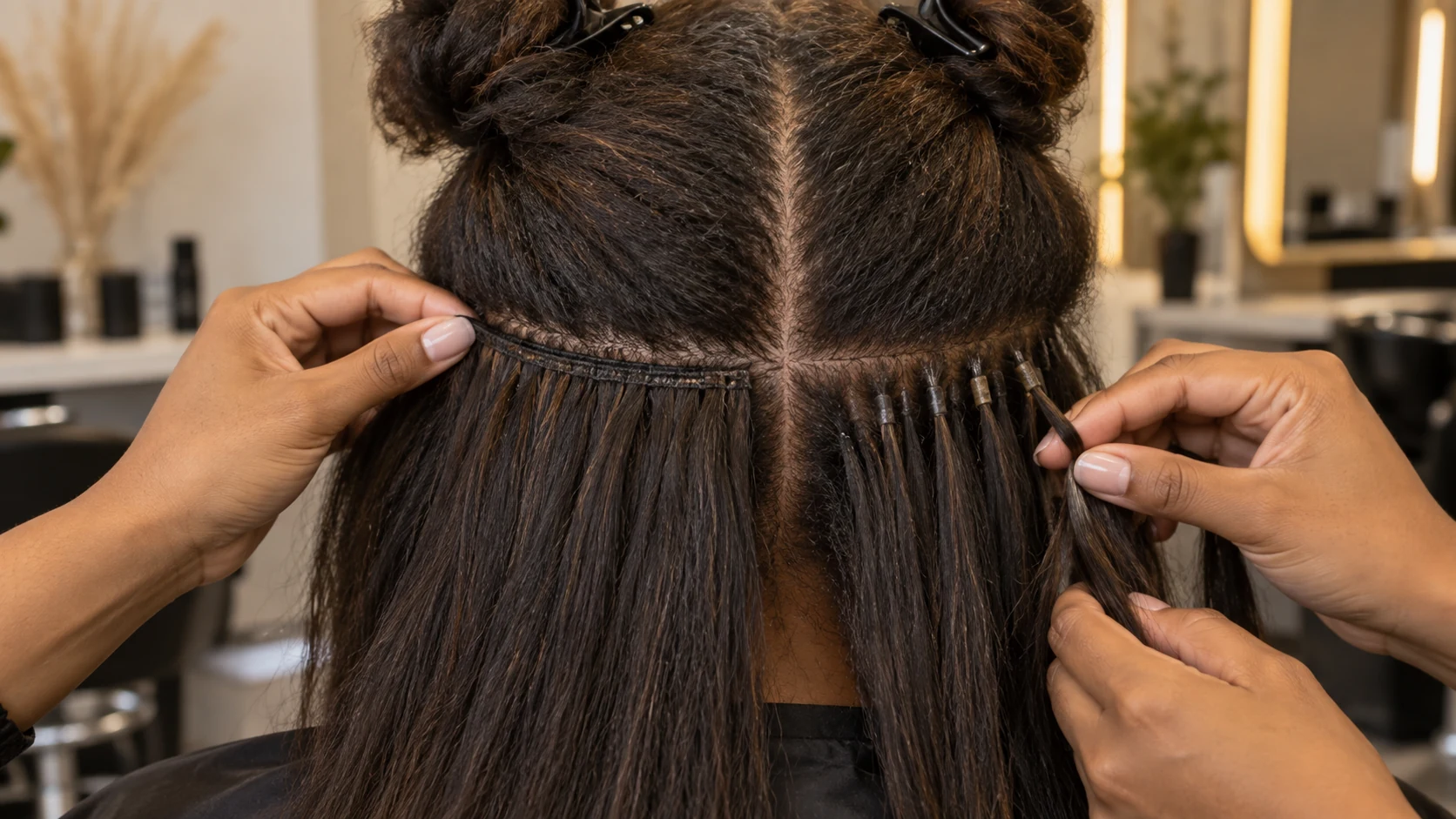
Invisible bead extensions and K-tips can both add length and fullness, but they distribute hair in very different ways. A beaded weft places extension hair along one or more rows. K-tips use many small individual bonds. That difference changes movement, concealment, scalp access, maintenance, and how the added weight is supported.
The better choice is not the method that looks most invisible in a social-media video. It is the one that fits your density, strand strength, styling habits, desired result, and ability to maintain the attachments. Neither method is automatically damage-free, and neither should be installed over active or unexplained thinning without first understanding what is happening.
How the Two Methods Are Built
An invisible bead installation uses small beads to create a foundation for a weft. The weft is then attached along that foundation so the beads and stitching remain concealed beneath the hair. Terminology varies between salons, and some named techniques are proprietary. Ask what materials and attachment pattern will actually be used rather than relying on the word invisible alone.
K-tips are individual extension strands with keratin-based bonds. Each bond is softened with a professional tool and shaped around a small section of natural hair. The bonds are distributed through selected areas instead of forming one continuous row.
How Each Method Carries Weight
A beaded weft concentrates extension hair along a row. A well-planned row spreads that load across multiple supported sections, but too much hair, too few support points, or excessive tension can still strain the natural hair. The installer must decide how many rows the client can support and how much hair belongs on each row.
K-tips divide the finished weight among many individual attachments. That can allow detailed customization, but a small bond can still be too heavy for the natural section holding it. Bond size, extension length, number of bonds, and placement must be considered together.
Movement, Styling, and Concealment
K-tips generally move in smaller independent sections, which can help with flexible parting and some upstyles. Their individual placement can also fill selected areas without extending a full row across the head. They still need enough natural hair above and around each bond for concealment.
A concealed beaded weft creates fullness efficiently across a broader area. It can be an excellent choice for clients who want significant density with fewer attachment zones. Because the hair follows a row, placement must anticipate the client's usual part, ponytail height, exercise routine, and preferred styling direction.
Neither method should rely on fragile temples, a compromised hairline, or areas that cannot comfortably support the attachment. A method can be technically hidden and still be unsuitable for the hair underneath.
Scalp Access, Washing, and Drying
K-tips create spaces between individual bonds, which can make some areas of the scalp easier to access. The number of bonds also means there are many small attachment points to separate, brush around, and dry thoroughly.
A weft creates a continuous row that requires deliberate cleansing above, below, and between rows. Product residue and trapped moisture should not be left around the beads or stitching. Complete drying matters with either method, especially after workouts, swimming, or a service that wets the attachment area.
The best choice is the one you can care for consistently. A beautiful installation that does not fit a client's wash schedule or dexterity can become difficult long before the planned removal date.
Maintenance and Removal Are Different
A beaded weft usually needs scheduled row maintenance as natural hair grows and the attachment moves away from the scalp. The stylist opens or replaces beads, checks the support hair, and repositions the row according to the service plan.
K-tips are not moved up in the same way. They remain in place for the planned wear period and are then removed individually. The released extension hair may be replaced with a new set or rebonded only when the product and professional process allow it.
Removal is part of the original service decision. Pulling a weft, cutting around beads, peeling bonds, or improvising with household products can cause avoidable breakage. Before installation, understand the maintenance schedule, removal process, total cost, and what happens if discomfort develops early.
Fine Hair, Low Density, and Active Thinning
Fine hair refers to strand diameter. Low density means fewer strands are present in an area. A person may have fine strands with enough stable density for a carefully scaled installation, while someone with coarser strands may have too little density to support the desired result.
Active shedding, unexplained thinning, traction alopecia, scalp inflammation, significant breakage, or a rapidly changing part can make attached extensions a poor immediate choice. Adding hair does not resolve the cause of thinning and may hide progression until the pattern is more advanced.
If density is changing, begin with the appropriate evaluation rather than choosing between two attachment methods. A dermatologist is the correct clinician for diagnosis, medical testing, medication, or inflammatory and scarring concerns. A trichology-focused Hair & Scalp Analysis can document the pattern, review routine and styling factors, and help direct the next step within its scope.
What Matters for Textured and Natural Hair
Texture matching affects more than appearance. The extension hair should behave predictably alongside the client's natural hair through humidity, washing, drying, and styling. Repeated heat used only to force two textures to blend can undermine the goal of a protective installation.
Sectioning and attachment placement should respect density changes across the head. The perimeter and crown may need a different plan from stronger interior areas. The finished style should not require tight ponytails, aggressive edge control, or constant root manipulation to remain polished.
When a Hybrid Plan May Make Sense
Some clients benefit from combining methods rather than treating the decision as all-or-nothing. A weft can create efficient fullness through stronger interior areas, while carefully selected individual bonds support blending where a full row would be visible or restrictive.
A hybrid installation is not automatically gentler because it uses fewer of one attachment. It still requires a complete weight map, a concealment plan, realistic maintenance, and a clear reason for every attachment used.
Questions the Consultation Should Answer
A useful consultation should determine whether density is stable, where the hair is strongest, which areas should remain attachment-free, how much length and fullness are realistic, and how the client normally wears and cares for the hair. Previous extensions, chemical services, breakage, scalp symptoms, shedding, exercise, swimming, and home-care capacity all belong in that discussion.
You should leave understanding the proposed method, approximate amount of extension hair, placement limits, maintenance timing, removal plan, and warning signs. If the recommendation cannot explain why the natural hair can support the design, appearance alone is not enough.
Warning Signs With Either Method
Persistent pain, stinging, headaches from tension, bumps, crusting, redness, visible pulling, or a new sparse area should not be dismissed as an adjustment period. Matting between attachments, natural strands breaking near the root, and attachments twisting together also require prompt attention.
Contact the extension professional early so the source of pressure can be adjusted or removed. If hair loss continues, the scalp is inflamed, or the pattern extends beyond the attachment areas, seek medical evaluation rather than reinstalling over the concern.
So Which Method Should You Choose?
Choose based on the natural hair first. Invisible bead extensions may suit someone who wants efficient fullness across supported rows and can commit to row maintenance. K-tips may suit someone who benefits from individual movement and highly customized placement. A hybrid or nonattached solution may be better when concealment, density, or lifestyle makes one method alone a poor fit.
GlamorChiQ extension planning reviews the natural hair, desired result, method, weight, placement, texture match, home care, and removal before installation. You can also read the K-tip guide for fine hair and the broader guide to reducing extension-related damage.
Choose the method around your natural hair
Start with a personalized extension plan that considers density, strength, placement, maintenance, and the result you want.
Explore Hair ExtensionsFrequently Asked Questions
Neither method is universally safer. Suitability depends on natural-hair density, strand strength, attachment weight, placement, tension, maintenance, and removal.
Fine hair may support a conservative version of either method when density is stable, but it may also be better served by fewer attachments or a nonattached option. Fine strands and low density are not the same consideration.
Both methods can support styling flexibility when attachments are placed around the client's preferred parts and ponytail positions. K-tips move individually, while a weft follows the shape of its row.
A beaded weft is released row by row by opening the beads and removing the stitching or attachment. K-tip bonds are individually softened and separated with the method intended for that bond. Both should be removed professionally.