
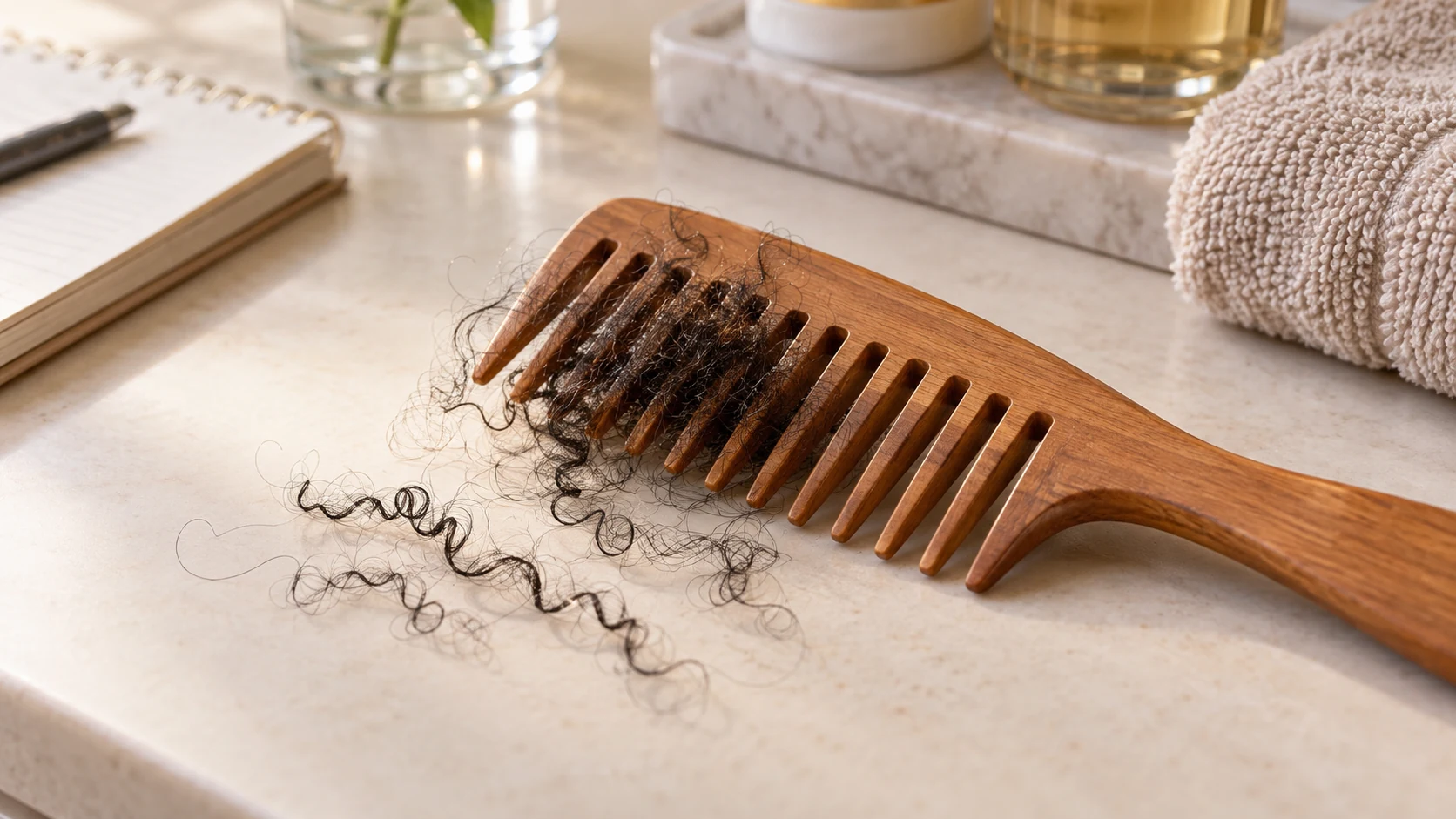
Finding more hair in the shower, brush, or sink does not automatically mean the follicles are failing. Hair naturally releases as part of its growth cycle. The useful question is whether the amount, timing, pattern, or density has changed from your own baseline.
A widely used reference is about 50 to 100 shed hairs per day, but that number is not a home diagnostic test. Hair length, density, curl pattern, wash frequency, detangling schedule, and protective styling change how shed strands appear. Someone who detangles once a week may see several days of normal shedding at once.
Start With Your Baseline, Not a Perfect Number
Pay attention to change. Is the amount clearly greater than it was during similar wash days? Is your ponytail circumference smaller? Is the part widening? Are you seeing more scalp under the same lighting and style? A consistent pattern over time is more useful than counting every strand from one shower.
Photographs can help when they use the same part, hairstyle, lighting, angle, and distance. A single close-up taken under bright overhead light can make normal scalp visibility look alarming. Monthly comparison photos are usually more informative than daily checking.
Shedding, Breakage, and Hair Loss Are Different
A shed hair usually releases from the follicle and may be close to the full length of your hair. The root end can show a small pale club. Breakage happens along the shaft, so the pieces may be shorter, uneven, frayed, or missing the club-shaped end. Read the full breakage versus shedding guide if loose hairs vary greatly in length.
Hair loss is a broader term. It can involve excessive shedding, progressive miniaturization, patchy loss, traction, inflammation, or scarring. Some people experience more than one process at the same time, which is why the visible pattern and scalp symptoms matter.
Why Wash Day Can Look Dramatic
Shed hairs do not always fall free immediately, especially in curly, coily, braided, twisted, or loc'd hair. They can remain caught among neighboring strands until washing and detangling. The hair collected after seven or ten days may look like a sudden event even though it accumulated gradually.
Look at the interval between wash days, the amount of manipulation, and whether the style held loose strands in place. Compare similar routines rather than comparing a weekly detangling session with a day when the hair was already loose and brushed.
When Shedding May Be Telogen Effluvium
Telogen effluvium is a common cause of diffuse shedding. A physical or emotional stressor shifts more follicles than usual into a resting phase. The increased shedding is delayed and often appears about two to four months after the triggering event, which is why the connection is easy to miss.
Possible triggers include childbirth, significant illness or fever, surgery, rapid weight loss, restrictive eating, major psychological stress, some medication changes, thyroid disease, and iron deficiency. A trigger can be plausible without being proven, and not every person remembers a clear event.
Acute telogen effluvium often improves after the trigger resolves, but the shedding and visible density do not recover on identical schedules. Shedding may taper before the hair looks full again because new growth needs time to gain length. Ongoing triggers, another hair-loss condition, or chronic telogen effluvium can change that course.
The Pattern May Point Away From Simple Shedding
Diffuse shedding across the scalp can fit telogen effluvium, but a widening center part or gradual crown thinning may suggest female pattern hair loss. Smooth round patches may suggest alopecia areata. Recession around tight styles may reflect traction. Tenderness, burning, bumps, scale, or loss centered at the crown can require prompt evaluation for an inflammatory or scarring condition.
These patterns can overlap. A temporary shedding episode may reveal density loss that was developing gradually, and extension or protective-style tension may occur alongside a medical cause. Do not assume that finding one trigger explains every change.
Extensions and Protective Styles Can Complicate the Picture
Braids, twists, wigs, wefts, and individual extensions can hold normally shed strands until the style is removed. Seeing retained hair at takedown does not by itself prove that the style caused hair loss. The amount must be interpreted alongside wear time, density, breakage, tension, and scalp symptoms.
Pain, bumps, visible pulling, broken perimeter hairs, widening attachment areas, or progressive thinning are different from ordinary retained shedding. Those signs call for prompt tension reduction and an evaluation before another installation.
What to Track Before an Appointment
Write down when the change began and whether it was sudden or gradual. Look back several months for illness, fever, surgery, childbirth, rapid weight change, major stress, medication changes, or a new styling practice. Record scalp symptoms and whether the loss appears diffuse, centered at the part or crown, concentrated at the edges, or present in patches.
Bring a complete medication and supplement list to a licensed healthcare professional. Do not stop a prescription or begin high-dose supplements because of shedding without appropriate guidance. Hair appearance cannot diagnose a nutrient deficiency, thyroid condition, hormonal disorder, or medication effect.
What an Evaluation Can Clarify
A dermatologist can diagnose hair and scalp disease, order appropriate tests, prescribe medication, and perform a biopsy when necessary. Medical evaluation is especially important for patchy loss, inflammation, scarring signs, systemic symptoms, or continued unexplained thinning.
A trichology-focused Hair & Scalp Analysis can document the pattern, compare shedding with breakage, review routines and styling stress, identify concerns that need referral, and help organize nonprescription care within scope. It should not be presented as a medical diagnosis or a replacement for a dermatologist.
When Not to Wait
Arrange timely medical care when shedding is abrupt or severe, the scalp is painful or inflamed, smooth bald patches appear, the crown is becoming shiny, eyebrows or body hair are affected, or hair changes arrive with fatigue, unexplained weight change, menstrual changes, dizziness, or other symptoms. Earlier assessment matters when a condition can permanently damage follicles.
If the change is gradual and you are unsure whether you are seeing shedding, breakage, or thinning, start by documenting the pattern instead of buying several products at once. The right next step depends on what is actually changing.
Not sure whether the change is shedding, breakage, or thinning?
Choose a virtual or in-person Hair & Scalp Analysis to document the pattern, review your routine, and identify the most appropriate next step.
Choose Your AnalysisFrequently Asked Questions
That range is a general reference, not a personal diagnostic cutoff. Hair length, density, wash frequency, detangling schedule, and protective styles change how much accumulated hair you see at one time.
A shed strand is often close to the full length and may have a small club-shaped root. Broken pieces are commonly shorter and may have frayed or uneven ends. Both can occur together.
Telogen effluvium is delayed because affected follicles enter a resting phase before the hairs release. Increased shedding is often noticed roughly two to four months after the trigger.
Seek medical evaluation for sudden or severe shedding, bald patches, pain, burning, sores, heavy scale, scarring, loss of eyebrows or body hair, systemic symptoms, or continued density loss without a clear explanation.